



Evaluating Total Cost of Ownership When Purchasing a Cummins Generator
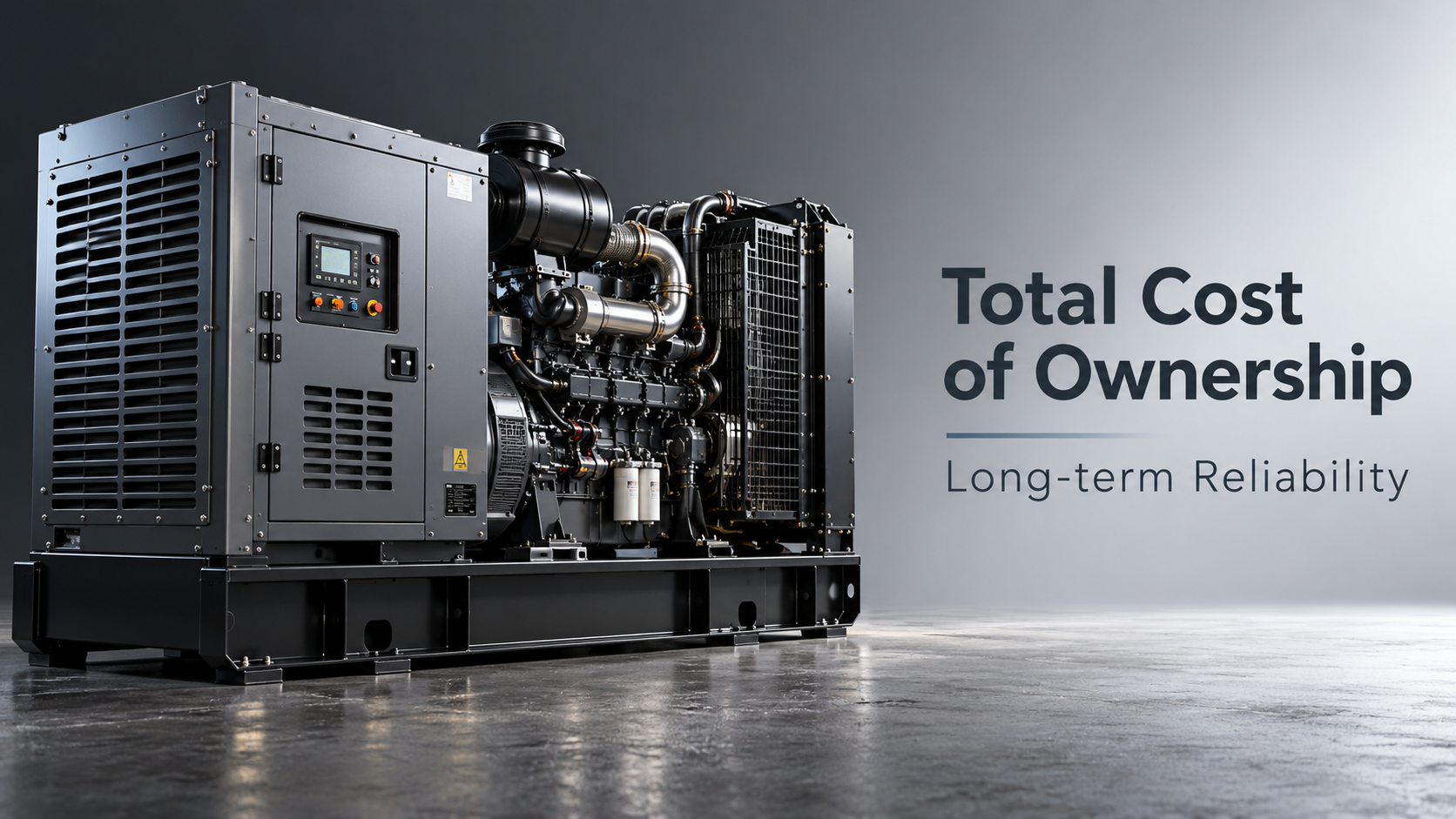
Evaluating Total Cost of Ownership When Purchasing a Cummins Generator
When procurement teams evaluate a Cummins generator, the initial capital expenditure often triggers immediate sticker shock compared to alternative brands. Relying solely on the initial purchase price is a common miscalculation in power generation procurement. The true financial impact of a power asset is only revealed through a rigorous Total Cost of Ownership (TCO) analysis. The preliminary judgment for buyers is straightforward: the premium paid for a Cummins unit is justified primarily in scenarios with high expected run hours, critical load requirements, or severe operational environments. For facilities where the generator serves strictly as a rarely tested backup, the TCO advantage narrows significantly, and the initial price difference becomes a heavier burden on the annual budget.
Fuel Consumption and Real-World Load Profiling
Fuel typically accounts for the largest share of a generator's lifecycle operational cost. Procurement professionals often request fuel consumption data at 100% load to compare different models. This approach is fundamentally flawed for most standby and prime power applications.
Generators in data centers, hospitals, or manufacturing plants frequently operate at partial loads ranging from 30% to 70% during utility outages or peak shaving events. Cummins engines, particularly those equipped with advanced electronic fuel injection and precise air handling systems, are engineered for optimal combustion efficiency across a broader load band. However, running any large diesel engine at consistently low loads can lead to wet stacking—a condition where unburned fuel accumulates in the exhaust system. This not only increases long-term maintenance costs but also reduces overall thermal efficiency.
A proper TCO evaluation requires overlaying the manufacturer’s specific fuel consumption curve against the facility’s projected load profile. Calculating the exact fuel cost over a 10-year period based on realistic partial-load scenarios, rather than peak-load brochure numbers, often shifts the financial comparison between brands. Additionally, modern Cummins units designed to meet strict EPA Tier 4 or equivalent emission standards utilize aftertreatment systems like Selective Catalytic Reduction (SCR) or Diesel Particulate Filters (DPF). The operational cost of Diesel Exhaust Fluid (DEF) and the maintenance of these aftertreatment components must be factored into the fuel and emissions-related TCO.
Maintenance Intervals, Parts Pricing, and Network Access
Preventive maintenance represents the second major operational expense. Cummins generators are designed with extended service intervals, which theoretically reduces the frequency of routine maintenance and lowers labor costs over the asset's life.
The cost of genuine replacement parts, filters, and fluids for a Cummins engine is generally higher than those for generic or locally assembled alternatives. If a procurement strategy focuses solely on minimizing immediate maintenance invoices by sourcing third-party components, it risks voiding warranties, accelerating engine wear, and ultimately increasing the frequency of major repairs.
The service network acts as a hidden but critical variable in the TCO equation. In remote mining operations or overseas industrial projects, the physical availability of parts and certified technicians dictates actual uptime. A slightly cheaper generator from a brand with poor regional support will incur massive logistical costs and extended downtime when a routine sensor fails. Evaluating the local dealer's inventory depth, technical capability, and response time is just as important as evaluating the engine's mechanical specifications. Furthermore, integrated telematics and remote monitoring capabilities offered with modern Cummins packages can optimize maintenance scheduling by predicting component failures before they occur, shifting the maintenance model from reactive to predictive.
Quantifying the Cost of Downtime and Reliability Premium
This is the most difficult variable to quantify but often the most decisive factor in the TCO model. For critical facilities like hospitals, semiconductor fabrication plants, or tier-III data centers, the cost of a power failure is measured in lost revenue, compromised patient safety, or ruined product batches per minute.
Cummins has built its market position on block acceptance capabilities—the ability to accept full rated load in a single step without stalling or experiencing excessive voltage dip. When a utility grid fails, the transition must be seamless to support heavy inductive loads like HVAC compressors and large motor arrays.
If a lower-cost alternative fails to start, or trips offline when the heavy loads engage, the financial damage will instantly eclipse the initial savings on the generator purchase. In these high-stakes environments, the reliability premium of a Cummins generator functions as an insurance policy. The TCO calculation must include a risk-adjusted cost of downtime, calculated as the probability of failure multiplied by the financial impact per hour of outage. For critical loads, this risk-adjusted cost heavily favors established, high-reliability brands with proven track records in mission-critical applications.
Residual Value and Lifecycle Extension
The end-of-life phase significantly impacts the final TCO calculation. Industrial equipment depreciates, but the depreciation curve varies wildly by brand reputation and market demand.
Cummins engines maintain exceptionally high residual values in the secondary market. When a facility upgrades its power infrastructure or a construction project concludes, a well-maintained Cummins generator can be sold or traded at a price that recovers a substantial portion of the initial capital expenditure. This high resale value effectively subsidizes the initial premium paid at the time of purchase.
Furthermore, the core architecture of heavy-duty Cummins diesel engines is designed to withstand multiple overhauls. Once the engine reaches its initial design life, a certified overhaul can restore it to near-original performance at a fraction of the cost of a new unit. This ability to extend the asset's productive life through major refurbishments effectively lowers the annualized TCO over a 20- or 30-year horizon. Lesser-known engine blocks often lack the metallurgical durability or the availability of overhaul kits required for such lifecycle extensions, forcing complete replacement earlier than necessary.
Building a Practical TCO Framework for Procurement
To move beyond theoretical comparisons, procurement teams should implement a structured TCO framework before issuing purchase orders. This ensures the evaluation aligns with the specific operational reality of the facility.
- Define the Application Rating: Clearly establish whether the unit is for Continuous, Prime, or Standby power. The expected annual run hours will dictate which cost components—fuel, maintenance, or downtime risk—carry the most financial weight.
- Demand Detailed Load Data: Request specific partial-load fuel and maintenance data from the supplier. Generalized brochure statistics are insufficient for accurate financial modeling.
- Calculate Long-Term Maintenance Costs: Project the 5-year and 10-year preventive maintenance costs using genuine parts pricing, factoring in local labor rates and the specific environmental conditions of the installation site.
- Estimate Residual Value: Determine the expected residual value at the end of the required service period based on historical secondary market data for the specific kW rating and engine model.
- Model Downtime Risk: For critical facilities, assign a financial value to potential downtime and adjust the TCO model to reflect the reliability differences between competing brands.
Evaluating the total cost of ownership is an exercise in aligning the asset's capabilities with the facility's operational and financial realities. A Cummins generator offers a distinct TCO advantage when reliability, fuel efficiency under varying loads, and high residual value are prioritized. By looking past the initial invoice and analyzing the complete lifecycle costs, procurement professionals can secure a power asset that genuinely protects the bottom line throughout its entire operational life.
Specialized field of steel wire ropes
24/7 before-sales and after-sales services
Comprehensive technical support