



Is a 30kW industrial generator set enough for a small workshop with heavy tools?
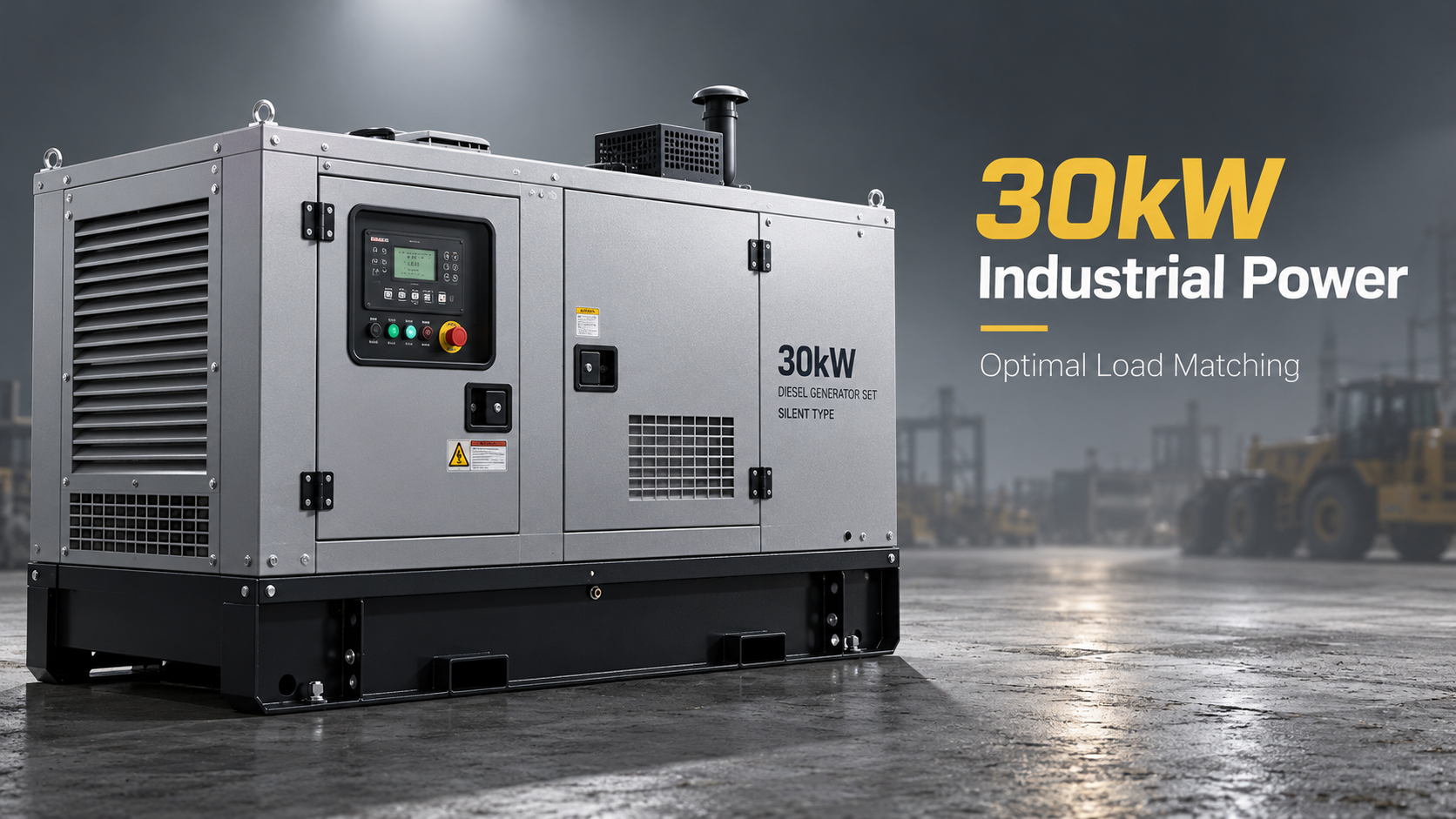
The hum of heavy machinery is the undeniable heartbeat of a manufacturing space. It is the sound of productivity, revenue, and progress. But when the local grid fails and that sudden, deafening silence takes over, the panic on a workshop floor is palpable. Every minute of downtime translates directly into lost income and frustrated clients. In the aftermath of a blackout, facility managers and business owners inevitably find themselves staring at equipment spec sheets, asking a very specific, high-stakes question: is a 30kW industrial generator set enough for small workshop operations that rely heavily on power-hungry tools?
While a 30kW diesel generator is a robust and highly capable piece of engineering, dropping it into a workshop full of heavy-duty equipment without a meticulous load analysis is a recipe for tripped breakers, stalled motors, and damaged electronics. To make a cost-effective and reliable decision, we need to look far beyond the basic nameplate ratings and understand what your shop floor actually demands.
The "Running Watts" Illusion and the Inductive Load Trap
It is incredibly common to see a workshop owner add up the running wattage of all their tools, see that the total sits comfortably under 25kW, and confidently order a 30kW backup unit. On paper, the math seems flawless. In reality, heavy tools do not play by the rules of basic arithmetic.
The critical mistake lies in confusing running watts with starting watts. Resistive loads, like space heaters or simple incandescent lighting, draw the same amount of power from the moment you flip the switch. But the heavy tools in your workshop—air compressors, industrial lathes, hydraulic presses, and large CNC machines—are inductive loads. They rely on electric motors.
When an electric motor starts, it must overcome physical inertia and establish a massive magnetic field to get the rotor spinning. This requires a massive surge of power, often three to six times the motor's normal running wattage, for just a few critical seconds. This is the starting wattage, or inrush current. If your generator cannot handle this momentary spike, the voltage will plummet. The motor will whine, struggle to start, and you risk burning out the generator's alternator or the tool's internal windings. A 30kW unit has a specific surge capacity, but it is not infinite, and it demands respect.
Doing the Math: The Real Appetite of Your Shop Floor
Let’s walk through a realistic scenario to see how quickly power demands escalate in a small fabrication or woodworking environment. Imagine a modest workshop with the following essential heavy equipment:
- A 5HP Air Compressor: This might run at about 4kW continuously, but it requires roughly 12kW to 14kW just to start the motor and pressurize the system.
- A Heavy-Duty MIG Welder: Welding equipment can be tricky. A high-amperage setup might draw 6kW to 8kW continuously during heavy welding sessions.
- A 10HP Industrial Table Saw or Lathe: Running at roughly 7.5kW, this machine demands a massive 22kW to 25kW at the exact millisecond you engage the switch.
- Industrial Dust Collectors and Ventilation: Large blower motors can easily add another 4kW of running power, with a starting surge of over 12kW.
- Lighting, Control Panels, and Auxiliary Circuits: Add a baseline of 2kW to 3kW.
If your workflow requires you to start the air compressor, turn on the dust collector, and fire up the lathe all at the same time to begin a shift, the starting surge alone could push the instantaneous demand past 45kW. The 30kW generator would instantly overload and shut down before the tools even reached their operating speed. The math gets messy very quickly. It is not just about what the tools consume while working; it is about what they demand the second they wake up.
The Hidden Variable: Power Factor and kVA vs. kW
Another layer of complexity that often trips up decision-makers is the difference between kilowatts (kW) and kilovolt-amperes (kVA). Generator nameplates frequently display kVA. The relationship between the two is dictated by the Power Factor (PF), which for most standard industrial diesel generators is 0.8.
This means a generator rated at 37.5 kVA will only deliver 30kW of real, usable power. If you are looking at equipment specs that list kVA, failing to convert this to kW will lead to a severe underestimation of your actual usable capacity. Always ensure your load calculations and generator ratings are speaking the same language—preferably real power (kW).
Defining the Boundary: Where Does a 30kW Unit Actually Shine?
So, where does a 30kW unit actually fit in? It is not a weak machine by any means. For many small workshops, it is the absolute perfect sweet spot, provided the operational strategy is sound and the tool mix is carefully managed.
A 30kW industrial generator is more than enough if your heavy tools are staggered. If your workflow allows you to start the air compressor, let it build pressure, and then manually start the heavy machinery one by one, a 30kW unit will handle the load beautifully. It is also highly effective for workshops where the "heavy tools" are modern, inverter-driven equipment. Modern machinery often features soft starters or variable frequency drives (VFDs) that drastically reduce that initial inrush current, making them much friendlier to smaller backup power systems.
However, if your production line requires three heavy motors to start simultaneously to maintain workflow continuity, or if you are running older, less efficient machinery with high starting currents, a 30kW unit will inevitably bottleneck your operations.
Navigating the Power Gap: What If the Numbers Don't Add Up?
This is the moment where many business owners feel stuck. You realize your peak demand is hovering around 40kW or 45kW. Do you automatically jump to a 60kW or 80kW unit? Not necessarily. Oversizing a diesel generator can lead to "wet stacking"—a condition where unburned fuel builds up in the exhaust system because the engine is consistently running under too light a load. This reduces fuel efficiency, increases carbon buildup, and drives up long-term maintenance costs.
Before increasing the physical capacity of the generator, evaluate your load management. Can you install an automatic load shedding system? These smart controllers can automatically drop non-essential circuits, like secondary HVAC units or non-critical lighting, the exact moment the heavy tools kick in, keeping you safely within the 30kW limit.
If the power gap is genuine, unavoidable, and load shedding isn't an option, you need a reliable partner to size the next tier correctly. This is where working directly with a source manufacturer makes a profound difference. Companies like Guangdong Yundong Diesel Generator (EPOWER) understand that every workshop's power profile is entirely unique. Rather than just pushing a larger, standardized box, they analyze your specific tool mix and operational rhythm.
Whether you need to step up to a 40kW, 50kW, or 100kW system, EPOWER configures units with premium, globally recognized engines like Cummins, Perkins, Mercedes Benz, or Yuchai. They ensure the alternator and the diesel engine are perfectly matched to handle your specific inductive loads. Furthermore, they provide tailored enclosure options. If your small workshop is located in a noise-sensitive urban area, they can supply a highly efficient silent canopy type. If you are in a well-ventilated, heavy industrial zone, an open-type or high-voltage configuration might be more practical. This one-stop power supply approach ensures the backup solution is as practical and cost-effective as it is powerful.
The Hidden Costs of Getting the Sizing Wrong
Choosing the wrong size is never just about the upfront capital expenditure of the generator itself. The financial bleed happens in the shadows of daily operations.
If you undersize and buy a 30kW unit for a 45kW shop, the costs accumulate in downtime and equipment damage. Every minute a heavy CNC machine or welding station sits idle because the generator tripped is lost revenue. More insidiously, constantly overloading a generator degrades the alternator's insulation and stresses the engine block, leading to premature, expensive failures.
Conversely, if you oversize to a 100kW unit "just to be safe," you are paying a massive premium for the initial equipment. You will burn significantly more diesel per hour during low-load operations, and the engine will suffer from the aforementioned wet stacking, requiring more frequent oil changes, filter replacements, and eventual major overhauls. The goal of backup power is precision, not just brute force.
Future-Proofing Your Workshop's Power Strategy
When making this final decision, you must look at your business trajectory. Are you planning to add more heavy machinery in the next two years? Is the local grid in your industrial zone becoming increasingly unstable due to regional power rationing? A 30kW unit might be perfect for today's setup, but if you are expanding, you need to ensure the physical space, exhaust routing, and heavy-duty wiring in your workshop can accommodate a future upgrade without requiring a total infrastructure overhaul.
Ultimately, answering whether a 30kW unit is enough for your specific small workshop requires looking past the simple numbers on a spec sheet. It requires a deep understanding of the behavior of your specific tools, the rhythm of your daily operations, and the long-term vision for your business. Take the time to audit your starting watts, consider your startup sequence, and consult with power specialists who can tailor a solution to your exact floor plan. Reliable power isn't just about having a backup sitting in the corner; it's about having the right backup that keeps your business heartbeat going strong, no matter what the grid decides to do.
Specialized field of steel wire ropes
24/7 before-sales and after-sales services
Comprehensive technical support