


Understanding EPA Emission Compliance Standards for Cummins Generators
For quality control and safety management professionals, deploying a Cummins generator for industrial backup power goes beyond simply matching kilowatt output to the facility's load. The most critical hurdle in modern power deployment is regulatory compliance. Navigating EPA emission standards is essential to avoid operational shutdowns, severe financial penalties, and environmental violations. Whether the application is a critical care hospital, a tier-three data center, or a remote mining site, understanding how the Environmental Protection Agency (EPA) categorizes and regulates these engines dictates the exact configuration you need to procure and how you must manage it on-site.
The Core Logic Behind EPA Emission Tiers
The EPA does not regulate diesel engines based solely on their power output; the regulations are fundamentally tied to the engine's intended use and operational profile. The emission standards, commonly referred to as Tier levels (such as Tier 2, Tier 3, and Tier 4/4F), represent progressively stricter limits on nitrogen oxides (NOx) and particulate matter (PM).
As the Tier level increases, the engineering required to achieve compliance becomes more complex. Moving from a lower tier to Tier 4 Final typically requires the integration of advanced aftertreatment systems, including Selective Catalytic Reduction (SCR) and Diesel Particulate Filters (DPF). For a safety manager, this is not just an environmental detail; it fundamentally changes the physical footprint, exhaust temperatures, and maintenance routines of the Cummins generator. Understanding this progression is the first step in ensuring the equipment you select is legally permissible for your specific site.
Application Classification: The Most Overlooked Compliance Factor
The most frequent compliance error made during procurement is misclassifying the application. The EPA strictly defines how a generator is used, and this classification determines which emission tier the engine must meet. Quality control teams must verify that the generator's certification matches the site's actual operational intent.
Emergency Standby vs. Prime Power
Emergency Standby Power (ESP): This classification is for engines that run only during power outages and for limited maintenance testing, typically capped at around 100 hours per year. Because the engine operates so infrequently, EPA regulations often allow ESP-rated Cummins generators to meet slightly less stringent non-road mobile standards (like Tier 3 or Tier 4 non-road) compared to engines that run continuously. However, if a facility exceeds the allowable run hours, it instantly loses its ESP exemption and becomes non-compliant.
Prime or Continuous Power: If the Cummins generator is intended to be the primary source of power in an off-grid location, or if it will run for extended hours to perform peak shaving or grid support, it must meet the strictest stationary engine standards, typically EPA Tier 4 Final stationary. Procuring an ESP-rated unit for a prime power application is a severe compliance violation that will fail any environmental audit.
Stationary vs. Non-Road Mobile
The physical installation also dictates the rulebook. A generator permanently bolted to a concrete pad in a factory is classified as stationary. Conversely, a generator mounted on a trailer and moved between construction sites or mining faces is classified as non-road mobile. The emission standards, testing cycles, and labeling requirements differ significantly between the two. Safety managers must ensure that mobile units are not mistakenly deployed as permanent stationary backup, as this violates the terms of their EPA certification.
Tier 3 vs. Tier 4 Final: Physical and Operational Impacts
When specifying a Cummins generator, the choice between Tier 3 and Tier 4 Final has direct implications for site safety and facility design. While Tier 3 engines rely primarily on internal combustion optimization to reduce emissions, Tier 4 Final engines require external aftertreatment.
This introduces several operational realities that safety and facility teams must plan for:
- Space and Layout: SCR and DPF systems require additional physical space on the generator skid. When working with customized enclosures, such as the silent or high-voltage configurations provided by source manufacturers like Guangdong Yundong Diesel Generator (EPOWER), the physical dimensions of the aftertreatment must be factored into the canopy design to ensure adequate airflow and maintenance access.
- Thermal Management: Aftertreatment systems operate at extremely high temperatures to regenerate the DPF. Safety protocols must be updated to include high-temperature surface warnings, thermal insulation checks, and strict clearance zones to prevent fire hazards.
- Chemical Handling: SCR systems require Diesel Exhaust Fluid (DEF). Safety managers must establish protocols for the safe storage, handling, and dispensing of DEF, ensuring it does not freeze in cold climates or become contaminated, which could lead to engine derating.
Verifying Compliance: What Quality Control Teams Must Check
Accepting a delivery without verifying compliance documentation is a critical risk. QC professionals must establish a rigorous verification process before the Cummins generator is commissioned.
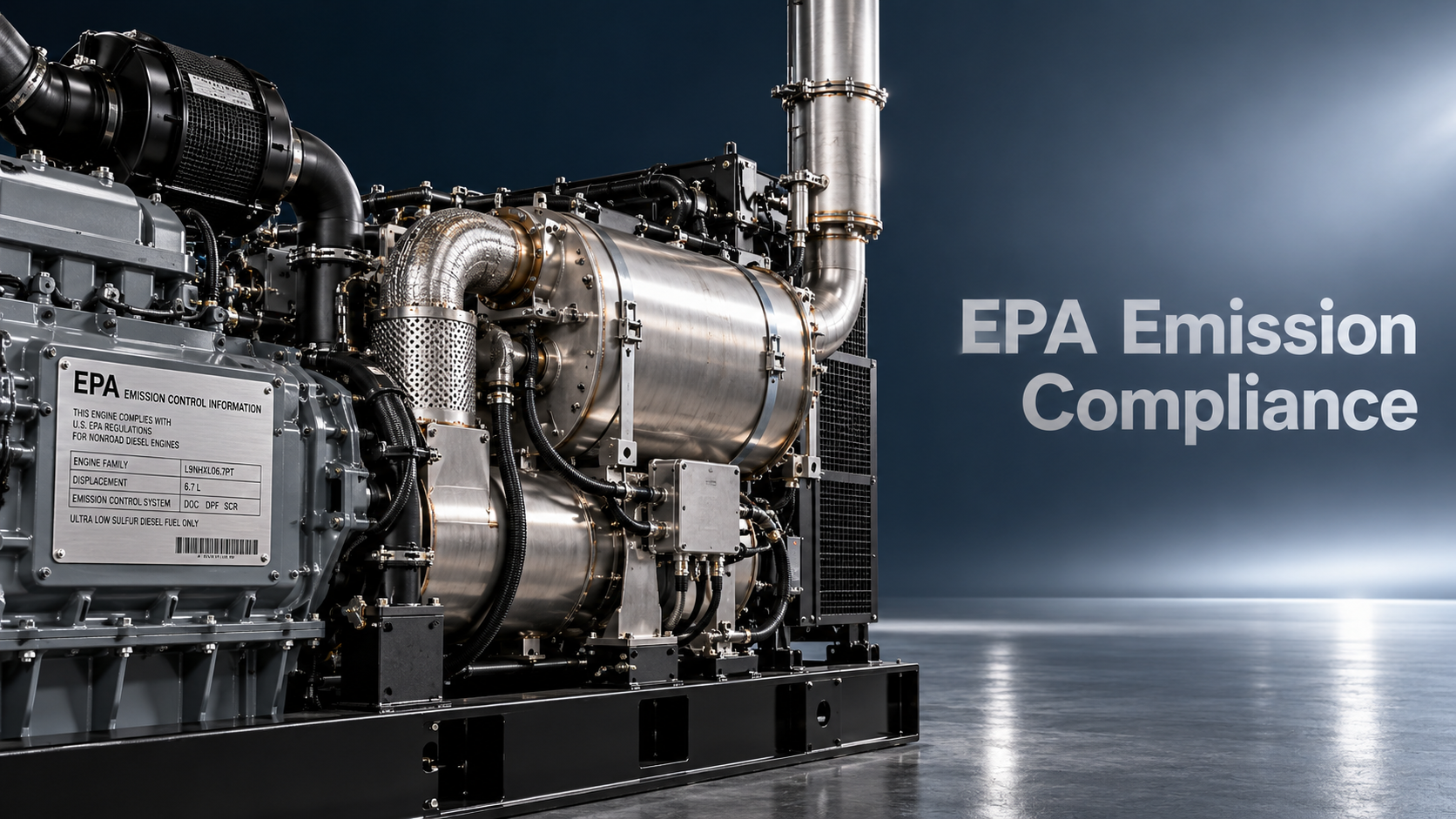
First, inspect the physical EPA Emission Control Label. This label must be permanently affixed to the engine block by the manufacturer. It details the engine family, the specific EPA tier it complies with, and the emission standards it meets. The information on this label must perfectly match the purchase order and the site's application classification.
Second, request the Certificate of Conformity (COC). This document proves that the engine model has been tested and certified by the EPA. Ensure the engine serial number on the COC matches the physical engine. When sourcing from integrated manufacturers that handle customized exports, such as EPOWER, it is crucial to confirm that the supplier provides complete, traceable compliance documentation tailored to the destination country's specific regulatory framework, bridging the gap between manufacturing and final deployment.
Common Pitfalls in Procurement and Site Deployment
Even with the right equipment, compliance can be compromised by poor operational practices. Safety and QC teams should watch for these common pitfalls:
- Ignoring Local Air District Rules: The EPA sets the federal baseline, but local air quality management districts (such as those in California or Texas) often have much stricter regulations, including lower run-hour limits for emergency engines or mandatory continuous emissions monitoring systems (CEMS). Federal compliance does not guarantee local compliance.
- Poor Maintenance of Aftertreatment: A Tier 4 Final Cummins generator will quickly become non-compliant if the DPF is not regenerated properly or if the SCR catalyst is degraded. Maintenance logs must specifically track aftertreatment system health, not just engine oil and filters.
- Unauthorized Modifications: Any modification to the engine, exhaust system, or electronic control module (ECM) that is not approved by the manufacturer voids the EPA certification. Safety teams must strictly prohibit unauthorized tuning or "defeat device" installations.
Strategic Next Steps for Safety and QC Professionals
Ensuring EPA emission compliance for a Cummins generator is a multi-disciplinary effort that begins long before the equipment arrives on site. The most effective approach is to align the engineering, procurement, and safety teams early in the project lifecycle.
Begin by conducting a precise audit of the facility's expected run hours and operational profile. This data alone will dictate whether you need an ESP-rated unit or a strict Prime/Continuous Tier 4 Final stationary engine. Next, evaluate the physical site constraints, ensuring there is adequate space for aftertreatment systems and that thermal safety zones can be established.
Finally, partner with experienced source manufacturers who understand the nuances of international and domestic emission standards. Whether you require open, silent, or specialized high-voltage power equipment for complex environments like data centers or mines, the manufacturer's ability to provide fully compliant, properly documented, and correctly configured diesel generator sets is your strongest defense against regulatory risk. By treating emission compliance as a core engineering parameter rather than an administrative afterthought, you ensure reliable, safe, and uninterrupted power for your most critical operations.
Specialized field of steel wire ropes
24/7 before-sales and after-sales services
Comprehensive technical support